A report by Natural Resources Canada released in Oct 2012.
A Preliminary Tsunami Hazard Assessment of the Canadian Coastline
The independent investigation into the causes of the Fukushima accident concluded that the accident was clearly “man made”. Fukushima Diet Report One of the main reasons for this conclusion was that they knew of a tsunami around 800 years ago that was much larger than the plant was designed for, but did nothing about it. Less than 100 years ago in 1929 there was a very large tsunami that hit the Burin Peninsula. It had wave runup of 13 meters. This kind of wave runup would flood Point Lepreau just as the tsunami wave did in Fukushima.
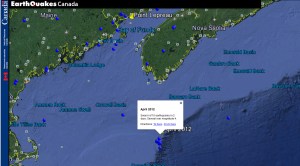
In April 2012 there was a swarm of 15 earthquakes on the edge of the continental shelf of the coast of Point Lepreau.
Some Highlights of the NRCan Study:
“The only historical landslide-triggered tsunami documented on the east coast of North America occurred in November 1929 and resulted in 28 deaths in Newfoundland, Canada (Table 1). An Ms 7.2 earthquake at the edge of the Grand Banks south of Newfoundland (Fig. 12) triggered a large submarine landslide-turbidity current on the continental slope that broke 12 seafloor telegraph cables (e.g., Heezen and Ewing, 1952). The landslide triggered a tsunami that traversed the continental shelf to strike southern Newfoundland; most damage and all fatalities occurred on the Burin Peninsula, where wave amplitudes of 3-8 m and runup up to 13 m were documented (e.g., Ruffman, 2001; Fine et al., 2005). Future submarine landslides along the Atlantic continental slope may also trigger destructive tsunamis; mapping has revealed that mass 28 failures much larger than the 1929 slide have occurred in the past (e.g., Piper and Ingram, 2003; Piper and McCall, 2003; Mosher et al., 2010).”
“Continental slope failures similar to the 1929 Grand Banks event also present a significant hazard to the Atlantic coast. Our assessment involves a number of simplistic assumptions that need to be tested with modelling and with the collection of more data. These assumptions include: (1) the size-frequency relationship of failures in Orphan Basin can be applied to other parts of the margin; (2) the threshold volume of tsunamigenic failures is 40 km
“Analysis of the Atlantic coast tsunami hazard (Table 23; Fig. 21) indicates that far-field subduction zone sources may be very significant, but the hazard is poorly constrained. Tsunami modelling is critically needed to identify which sections of coastline are at risk from each potential source”
“Mosher et al. (2010) tested two scenarios for their impact on Halifax, Nova Scotia, located ~200 km north of the source across the continental shelf. In the first scenario, only the 117 km 3 slump portion is modelled, resulting in a maximum wave amplitude of 13 m (above the state of tide) at Halifax; modelling of a simultaneous 862 km3 failure incorporating both the slump and debris flow produces a 25 m wave at Halifax. However, the use of instantaneous vertical displacements may have overestimated the amplitudes.”


 New Clear Free Solutions